
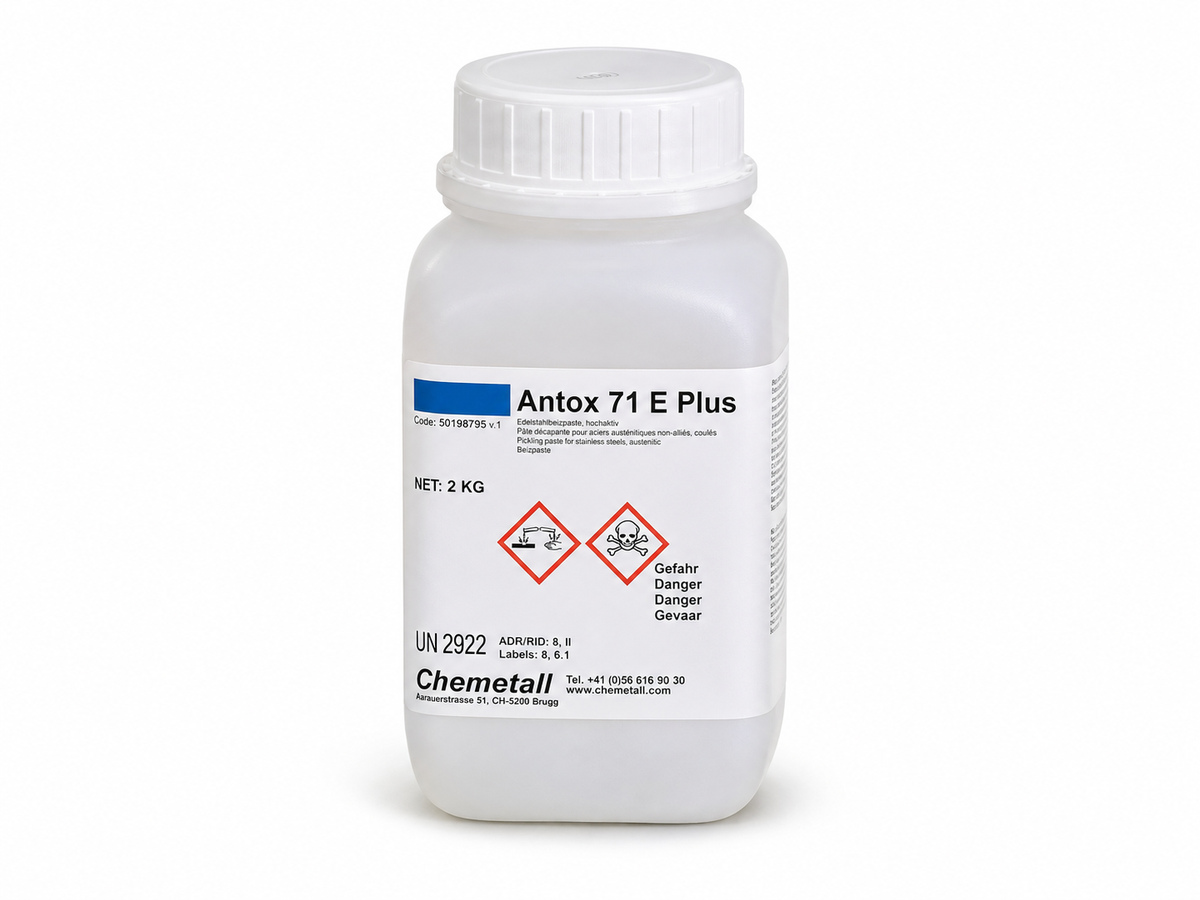
Antox 71E Plus Pickling Paste for Stainless Steel Welds
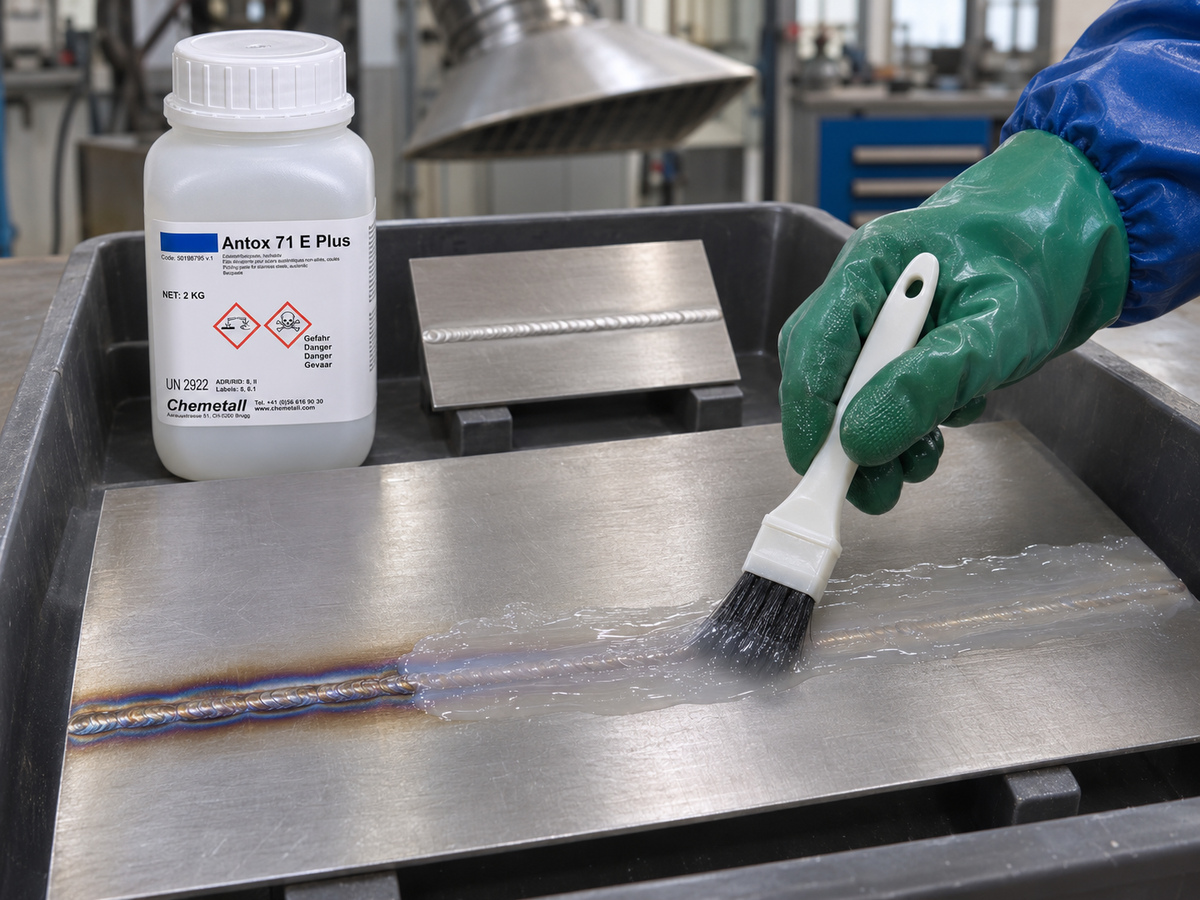
Welding stainless steel leaves heat tint and a chromium-depleted oxide layer along the seam. Left in place, that discoloured zone is where corrosion starts. Pickling removes it chemically so the steel can re-form its protective passive layer, which is why fabricators, food and pharmaceutical plant builders, and marine and architectural metalworkers pickle their welds.
Antox 71E Plus is a thixotropic pickling paste made by Chemetall. It stays where it is brushed, including on vertical and overhead welds. Moleroda supplies it in 2kg tubs and 10kg containers, and 1kg treats approximately 80–150 running metres of weld seam, including the heat-affected zone.
Antox 71E Plus contains nitric and hydrofluoric acid. Handle it only with suitable PPE, and neutralise it before rinse water goes to drain. Because of the acid content it travels by specialist carriage, which is why it is priced on application.
Pickle, Neutralise, Passivate
A complete post-weld treatment usually has three stages. Antox makes a product for each, and they are designed to be used together.
| Stage | Antox Product | What It Does |
|---|---|---|
| 1. Pickle | Antox 71E Plus | Removes heat tint, weld burn and oxide scale from the seam and heat-affected zone |
| 2. Neutralise | Antox NP | Neutralises the acid paste on the surface before rinsing, so rinse water can be discharged safely |
| 3. Passivate (where specified) | Antox 90E | Speeds up re-forming of the passive oxide layer after pickling or after mechanical finishing |
Pickling alone lets the passive layer re-form naturally in air. Add a passivation stage where a specification or hygiene standard requires it, or where the surface has also been ground or polished.
Antox products are designed to work together. Chemetall advises that they may not perform as intended when mixed with other manufacturers’ products, so neutralise and passivate with the matching Antox products.
How to Use Antox 71E Plus
Read the safety data sheet first.
Work outdoors or in a well-ventilated area, wearing chemical-resistant gloves, an apron and eye and face protection.
- Clean the surface. Remove grease, oil and loose contamination from the weld area.
- Stir the paste well. The liquid and paste separate during storage and must be mixed back together before use.
- Apply by brush. Use an acid-resistant brush to cover the weld seam and the full heat-affected zone evenly.
- Leave it to react. Allow typically 15–60 minutes, depending on temperature, steel grade and how heavy the discolouration is. Do not let the paste dry on the surface.
- Neutralise. Brush Antox NP directly over the pickling paste in roughly the same quantity. The paste bubbles as it reacts, and neutralising is complete once the bubbling stops.
- Rinse thoroughly. Rinse with clean water, ideally high pressure, until no residue remains. Dispose of rinse water in line with local regulations.
Antox 71E Plus can leave a faint white halo around the pickled area. Where that matters, ask about Antox 3D, which does not leave a halo.
The Antox Range – Supplied on Request
Moleroda can supply the full Antox stainless steel treatment range, in the manufacturer’s standard pack sizes. Tell us the product and quantity when you enquire.
| Product | Type | Choose It For |
|---|---|---|
| Antox 71E Plus | Pickling paste | The strongest and fastest Antox paste, for weld seams and heat-affected zones |
| Antox 3D | Pickling paste (non-toxic) | Removing weld burn where a non-toxic paste is preferred and no white halo is acceptable |
| Antox NP | Neutralising paste | Neutralising acid pickling paste before rinsing and discharge |
| Antox 73E | Spray pickle | Uniform pickling of tanks, vessels and large surface areas |
| Antox 80E | Bath pickle | Immersion pickling of small or complex parts |
| Antox 90E | Passivator | Re-forming the passive layer quickly after pickling or mechanical finishing |
| Antox 95E | Rust remover and passivator | Removing rust spots and passivating in one step, without hydrofluoric acid |
| Antox 76E | Mild pickle, cleaner and passivator | Cleaning, degreasing, removing iron contamination and passivating in one solution |
| Antox 2001T | Cleaner and mild pickle | Removing rust spots and light TIG weld tint, and brightening the surface |
| Antox 75E | Cleaner and degreaser | Degreasing and removing iron (Fe) contamination |
| Antox 800S | Surface cleaner and polish | Removing fingerprints and light soiling from finished stainless steel |
| EWP 51 | Citric passivator and cleaner | Citric acid passivation and cleaning |
Which Weld Cleaning Method Should I Choose?
| Product | Choose It When |
|---|---|
| Antox 71E Plus Pickling Paste | You need the fastest chemical treatment for long weld runs, heavy heat tint or awkward fabrications, and can handle hydrofluoric acid safely. Supplied in 2kg or 10kg. |
| Electro Wand Weld Cleaner EW Combi Kit | You want to clean TIG welds without hydrofluoric or nitric acid, using an electrolytic brush and paddle with a phosphoric acid electrolyte. Supplied as a complete kit in 110V or 240V. |
Cleaning Large Areas or Complex Parts?
Ask about Antox 73E spray pickle for large surfaces, or Antox 80E for bath pickling small parts. Contact Moleroda for availability.
Handling, Safety and Carriage
- Hazardous contents: Antox 71E Plus contains nitric acid (20–25%) and hydrofluoric acid (5–7%) and causes severe skin burns and eye damage. Read the safety data sheet before use.
- PPE: wear chemical-resistant gloves to EN 374, such as PVC gauntlets, tightly fitting splash goggles to EN 166, face protection and an industrial PVC apron. See all protective clothing.
- Workplace: use outdoors or with good ventilation, with local exhaust where needed. An emergency shower and eyewash should be available.
- Disposal: neutralise with Antox NP before rinsing, and dispose of rinse water and residues in line with local regulations.
- Storage: store upright in the original closed container, in a cool, ventilated place between 0 and 40°C. Protect from frost and direct sunlight, and keep away from alkalis and metals. Stir before every use.
- Carriage: classed as dangerous goods (UN2922, Class 8 with a 6.1 toxic subsidiary hazard, packing group II), so it is shipped by specialist carriage and quoted per order.
Product Specifications
| Brand | Antox (Chemetall) |
|---|---|
| Product type | Thixotropic stainless steel pickling paste |
| Pack sizes | 2kg tub, 10kg container |
| Coverage | Approximately 80–150 running metres of weld seam per 1kg |
| Typical reaction time | 15–60 minutes, depending on temperature, grade and discolouration |
| Active ingredients | Nitric acid and hydrofluoric acid |
| Suitable materials | Stainless steels, including high-alloy grades, plus titanium, nickel and their alloys |
| Application | Acid-resistant brush |
| Neutraliser | Antox NP – supplied on request |
| Ordering | Price on application – specialist carriage (UN2922, Class 8 (6.1), packing group II) |
| Typical applications | Post-weld cleaning of TIG, MIG and spot welds on fabrications, pipework, tanks and food, pharmaceutical, marine and architectural stainless steel |
Need Help Choosing an Antox Product?
Contact Moleroda with the material and grade, the type and length of weld, the size of the parts, and whether passivation is specified.


