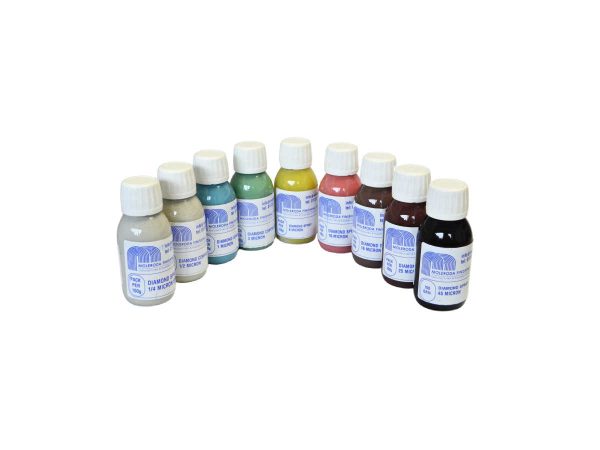
Diamond lapping is a precision finishing process that uses diamond abrasives to produce extremely flat, smooth surfaces on hard materials such as carbide, ceramics, hardened steel and glass. Because diamond is the hardest known material, it can cut and polish materials that conventional abrasives struggle to finish.
During lapping, micron-graded diamond particles are applied between the workpiece and a lapping surface, gradually removing small amounts of material to improve flatness and surface finish. Diamond lapping is widely used in industries such as mould and die manufacturing, aerospace, medical devices and precision engineering where tight tolerances and mirror finishes are required.
Diamond compounds and suspensions allow operators to control the cutting rate and surface finish by selecting the appropriate particle size.
Common Applications of Diamond Polishing Compounds
Diamond polishing products are widely used across many industries where high precision surface finishing is required.
Typical applications include:
-
Mould and die polishing
-
Tool and cutter finishing
-
Metallographic sample preparation
-
Optical component polishing
-
Ceramic and carbide finishing
-
Precision engineering and aerospace components
Because diamond abrasives remain sharp and wear slowly, they provide consistent cutting performance and repeatable results even when working with extremely hard materials.
Diamond Paste or Diamond Suspension - Which Should You Use?
Diamond polishing compounds are available in two main formats: diamond paste and diamond suspension.
Both products contain micron-graded diamond particles used to polish extremely hard materials such as hardened steels, carbide and ceramics.
The main difference is how the diamond abrasive is delivered to the surface.
| Feature |
Diamond Paste |
Diamond Suspension |
| Best for |
Manual polishing |
Machine polishing |
| Application |
Felt bobs, wooden laps, hand tools |
Lapping plates, polishing cloths |
| Precision |
Excellent control in detailed areas |
Better for larger flat surfaces |
| Ease of Application |
Apply directly to tool or surface |
Spray or dose onto polishing surface |
| Typical Industries |
Mould polishing, tool & die |
Metallography, automated finishing |
Diamond suspension consists of diamond particles evenly dispersed in a liquid carrier, allowing uniform distribution of abrasive across polishing surfaces and automated dosing systems.
Diamond paste, by comparison, is a thicker compound designed for precise manual application, making it ideal for polishing detailed surfaces and small features.
Choose Diamond Paste if:
-
you are polishing mould cavities or detailed parts
-
you require precise manual control
-
you are using felt bobs or wooden laps
Choose Diamond Suspension if:
-
you are using flat lapping plates
-
you need automated polishing
-
you require even abrasive distribution across large surfaces
Choosing the Right Diamond Micron Size
Diamond polishing compounds are classified by micron size, which refers to the size of the diamond particles in the abrasive. Smaller micron sizes produce finer finishes, while larger micron sizes remove material more quickly.
Typical diamond polishing progressions move from coarse grades for stock removal to ultra-fine grades for mirror polishing.
| Micron Size |
Typical Use |
| 25 – 45 micron |
Rapid stock removal and initial lapping |
| 6 – 14 micron |
Pre-polishing and scratch removal |
| 1 – 3 micron |
Fine polishing |
| 0.25 – 1 micron |
Mirror finishing and final polish |
Very fine diamond grades such as 3 micron down to 0.25 micron are commonly used to remove microscopic scratches and produce highly reflective surfaces.
Selecting the correct micron size helps achieve faster polishing while maintaining consistent surface quality.
Lapping Fluids and Diamond Polishing
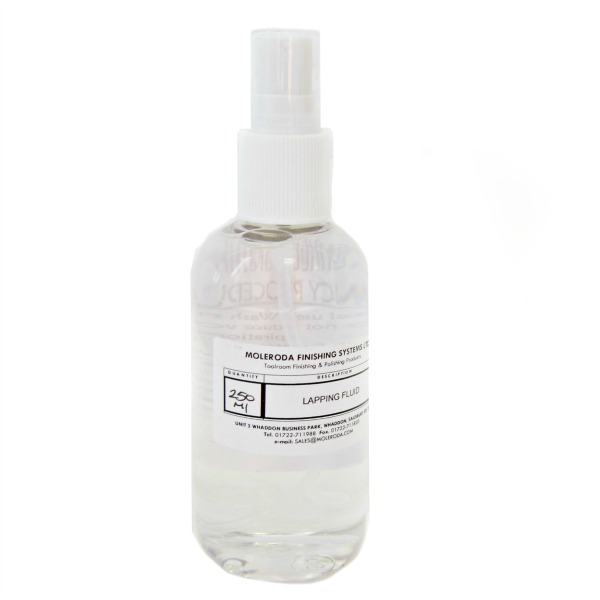
Diamond polishing compounds are often used with lapping fluid or extender lubricants. These fluids improve lubrication, reduce heat and help distribute the abrasive evenly across the polishing surface.
Using the correct combination of diamond compound, suspension and lubricant helps achieve consistent cutting action and high-quality surface finishes.