


Bench Polishers & Lathes
Price range: £221.28 through £254.92 incl VAT

Bench Polishers & Lathes
8″ Bench Grinder / large workshop bench polisher – perfect for metal polishing
Price range: £219.26 through £392.02 incl VAT


Bench Polishers & Lathes
Call us to find out the current price for this product


Bench Polishers & Lathes
Call us to find out the current price for this product


Bench Polishers & Lathes
Price range: £832.60 through £907.56 incl VAT

Choose by the size of mop you need to run, the material and how much use the machine will get.
| Machine | Key Specification | Choose It When |
|---|---|---|
| Foredom Bench Lathe M.BL | 125 W, variable 500–7,000 rpm, tapered spindles for wheels up to 4″ | You polish jewellery and small parts on a small bench and want fine speed control. |
| Universal Bench Polisher BM39B | 500 W, two speeds: 1,400 and 2,800 rpm | You want a professional two-speed polisher for jewellery, restoration and engineering work. |
| Bench Polisher DSM 200 | 900 W, 3,000 rpm, 200mm discs, 20mm threaded shaft, cast iron | You need an industrial machine for continuous polishing, CNC line removal, surface preparation and deburring. |
| Double Ended Bench Polisher 1.5hp | 2,820 rpm, single phase, No.2 tapered spindle ends optional | You run large mops up to 10″ for heavy metal polishing, such as aluminium and stainless steel. |
| 6″ Bench Polisher / Grinder BG150-XD | 450 W, 2,850 rpm, 13mm axle, supplied with grinding stones | You want a heavy duty bench grinder that converts to a polisher with a pigtail. |
| 8″ Bench Grinder / Polisher | Takes wheels up to 200mm, heavy duty or standard | You want a larger workshop grinder to convert to polishing with tapers. |
| Poli Base Polishing Unit | Compact unit with integrated suction and micro fine dust filter | You polish jewellery, dental, optical or industrial parts and need built-in dust extraction. |
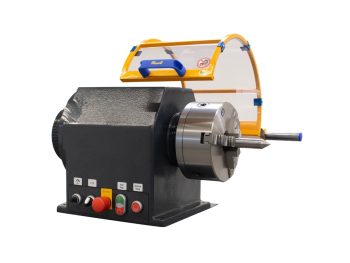
| JOKE Polierbock UVM | Configurable, three-speed Junior or variable Regatron drive | You need an industrial polishing or precision lathe built around your workpiece. Priced on application. |
Mops, Compounds and Pigtails
Polishing on a bench machine works in stages: a firm mop with a cutting compound, then softer mops with finer polishing compounds. Choose polishing mops and polishing compounds to suit the material, or start with a bench motor polishing kit.
Converting a bench grinder? Remove the grinding stones and fit a tapered pigtail to each end of the shaft, matched to the shaft diameter, so mops can be wound on and off.
Need a stand? The floor standing pedestal (900mm high, 465 x 465mm base) takes the 6″ and 8″ bench grinders and the 1.5hp double-ended polisher off the bench.
Safe Bench Polishing
- Secure the machine to a stable bench or pedestal before use.
- Check that the mop or wheel is rated for at least the spindle speed of the machine.
- Present the work below the centre line of the mop, so it is pulled away from you if it catches.
- Wear eye protection and use a dust hood with extraction. Polishing produces fine dust and compound residue.
- Have larger three-phase or hard-wired machines installed by a qualified electrician.
Need Help Choosing a Bench Polisher?
Contact Moleroda with the material, the size of the parts, the mop size you plan to use and how many hours a day the machine will run.
Frequently Asked Questions (FAQs)
What is the difference between a bench grinder and a bench polisher?
A bench grinder runs grinding stones on a short shaft. A bench polisher carries polishing mops on tapered or threaded spindles. Fitting a tapered pigtail to a bench grinder converts it for polishing.
What size mop can I use?
It depends on the machine. The Foredom Bench Lathe takes wheels up to 4″, the 8″ grinder up to 200mm, and the 1.5hp double-ended polisher up to 10″. Always check the mop is rated for the machine speed.
Which bench polisher suits jewellery?
The Foredom Bench Lathe and the two-speed BM39B suit most jewellery benches. Choose the Poli Base where built-in dust extraction is required.
Do I need extraction?
Extraction is strongly recommended, because polishing produces fine dust and compound residue. The Poli Base has integrated suction; other machines can be used with a dust hood and extraction unit.
What is a polishing lathe?
A polishing lathe holds the mop or wheel on an extended spindle, giving more clearance around the work than a bench grinder. The JOKE Polierbock UVM range adds configurable workholding, controls and guarding for industrial use.