

Emery cloth is commonly used to polish, deburr or size turned components, but applying it directly by hand to rotating work creates a serious entanglement hazard. If the abrasive snags, it can pull the operator’s fingers, hand, clothing or body towards the workpiece, chuck or other moving parts.
The Health and Safety Executive (HSE) states that direct hand application is not an acceptable method on either manual or CNC metalworking lathes. A risk assessment should first consider whether the abrasive operation can be eliminated or completed using a more suitable tool or machine. Where emery cloth remains necessary on a manual lathe, it must be applied using an appropriate tool-post-mounted method.
This guide explains that hierarchy and the role of guarding, safe workholding, training, stop controls and electromagnetic braking.
The guide also considers when a purpose-built polishing and precision-lathe system—such as the configurable JOKE Polierbock UVM range—may provide a more appropriate foundation for a controlled finishing process than adapting a conventional production lathe.
Important:
An emergency stop, reduced operating speed or electromagnetic brake does not make it acceptable to hold emery cloth by hand against rotating work.
These are supporting protective measures, not substitutes for eliminating the hazard or using a suitable holding device and safe system of work.
The Essential HSE Rule
HSE guidance draws a clear line between direct hand application and controlled application using suitable equipment:
Unacceptable
- Holding emery cloth directly by hand against work rotating in a manual lathe
- Wrapping or winding the abrasive around the component, fingers or hand
- Applying emery cloth by hand—or with a backing board or similar hand-held device—inside a CNC lathe
- Defeating or bypassing guards and interlocks to gain access to rotating work
- Relying on gloves, low speed, an emergency stop or rapid braking to make direct hand application acceptable
Acceptable Following Assessment
- Eliminating the abrasive operation where it is not required
- Using a machining, polishing, honing, grinding or linishing process that removes the need for hand-held emery cloth
- For external work on a manual lathe, clamping a looped strip of emery cloth in a suitable tool-post-mounted arrangement
- For internal work on a manual lathe, securing the abrasive to an appropriate holding device carried in the tool post
- Documenting the method and providing suitable information, instruction, training and supervision
HSE’s dedicated guidance applies to emery cloth. Other flexible abrasive cloths or papers can present the same snagging and entanglement mechanism, so changing the abrasive name or backing does not remove the need to assess and control the rotating-machinery hazard.
Why Hand-Held Emery Cloth Is Dangerous
The risk is not limited to deliberate wrapping of the abrasive around the workpiece. A loose edge can catch on a shoulder, keyway, thread, chuck jaw or irregular feature. The rotating component can then take up the cloth faster than the operator can release it.
Possible consequences include lacerations, fractures, dislocations, amputations and fatal entanglement. Gloves can make the situation worse by adding material that can be caught and drawn into the rotating parts. Loose clothing, ties, jewellery and unsecured long hair create additional entanglement hazards.
The severity of the risk also means that apparently reassuring factors should not be treated as controls:
- Experience: familiarity with a task does not prevent an abrasive strip from snagging.
- Short duration: entanglement can begin in a fraction of a rotation.
- Lower speed: a lower spindle speed may change the process, but it does not make direct hand application acceptable.
- A nearby stop button: an operator who has already been caught may be unable to reach or operate it.
- Rapid braking: braking begins only after a stop has been initiated; it cannot prevent the initial contact or snag.
Recent HSE Prosecutions
The consequences are not theoretical. In February 2026, HSE reported two separate prosecutions involving hand-held emery cloth and metalworking lathes. One followed a 2024 incident in which an employee’s glove was drawn into a lathe and a finger was amputated. The other followed a fatal 2023 incident in which a machinist became entangled while finishing a rotating component.
HSE’s investigations identified failures including inadequate risk assessment, failure to prohibit the dangerous practice, failure to prevent access to moving machinery and the absence of an effective safe system of work.
Read the HSE finger-amputation prosecution
Read the HSE fatal-entanglement prosecution
Assess the Finishing Process Before Selecting a Method
The correct starting point is not to find a safer way to hold the abrasive by hand. It is to decide whether emery cloth is needed at all.
HSE’s Engineering Information Sheet EIS2 says the risk assessment should first consider eliminating emery cloth. Questions include:
- Can the required finish or diameter be achieved during the normal machining cycle?
- Can a properly set lathe tool complete the deburring operation?
- Would a dedicated polishing, honing, grinding or linishing machine provide a more suitable process?
- Is the finish functionally necessary, or is an avoidable cosmetic operation being introduced?
- Can the component, abrasive or tool be supported so the operator’s hands remain outside the danger zone?
Only after elimination and alternative processes have been considered should a controlled emery-cloth method on a manual lathe be assessed. The findings should be incorporated into the safe operating procedure and reviewed when the component, material, tooling, machine or working method changes.
Acceptable Methods on a Manual Lathe
Where a suitable and sufficient risk assessment concludes that emery cloth remains the most practicable method on a manual lathe, HSE identifies different arrangements for external and internal work.
External Work
A looped strip of emery cloth is clamped and held by a suitable device attached to the tool post. The tool post supports the abrasive and keeps the operator’s hands away from the rotating component.
This method is for external deburring work. The holder, abrasive width, contact position and machine settings must be appropriate for the component and operation.
Internal Work
The emery cloth is secured around a suitable holding device carried in a boring-bar holder in the tool post. The abrasive is therefore presented and controlled by the machine setup rather than by the operator’s hand.
This method is intended for internal deburring. Access, clearance, abrasive retention and the possibility of the holder contacting the workpiece must all be assessed.
These arrangements reduce risk; they do not remove the need for correct guarding, secure component holding, appropriate speed and direction, competent setup, training, supervision and inspection of the complete system.
CNC Lathes Require a Different Approach
HSE states that emery cloth should not be applied directly by hand—or by using a backing board or similar hand-held device—on a CNC lathe. Doing so would require access to the danger zone and may involve defeating interlocked guarding. Suitable machine tooling should instead be used to achieve the required finish or close-tolerance diameter.
View HSE’s demonstrations and detailed guidance:
Using emery cloth on metalworking lathes
EIS2: The use of emery cloth on metalworking lathes
How PUWER Applies
The HSE emery-cloth guidance describes the specific hazard and acceptable methods. The Provision and Use of Work Equipment Regulations 1998 (PUWER) provide the wider framework for selecting, controlling and using work equipment safely.
Relevant duties include:
- Suitability: work equipment must be suitable for its intended use and the conditions in which it will be used.
- Information and training: operators, supervisors and managers need adequate information, instruction and training about the method, risks and precautions.
- Dangerous machinery parts: effective measures must prevent access to dangerous parts or stop their movement before a person enters the danger zone.
- Stop controls: where appropriate, readily accessible controls must bring equipment to a safe condition in a safe manner.
- Emergency stopping: where appropriate, readily accessible emergency-stop controls must support a rapid response to an irregular dangerous event.
- Inspection and maintenance: safety-related equipment must remain in efficient working order and be inspected where necessary to manage risk.
PUWER’s hierarchy for dangerous machinery gives priority to preventing access through fixed guards, followed by other guards or protection devices, protection appliances and then information, instruction, training and supervision. An emergency stop is not a substitute for safeguarding.
Compliance cannot be established by the presence of one machine feature. It depends on the equipment, component, workholding, abrasive or tool, guarding, controls, installation, operating procedure, maintenance and competence of the people involved.
Further information:
HSE: PUWER overview
HSE L22: Safe use of work equipment
Emergency Stopping, Run-Down and Electromagnetic Braking
A lathe spindle, chuck and workpiece retain rotational energy after drive power is removed. Without effective braking, they may continue turning during the run-down period. This is why stopping performance matters—but different parts of the stopping system perform different functions.
Normal Stop Control
Initiates the machine’s intended stopping sequence and brings it to a safe condition in a safe manner.
Emergency Stop
Provides a readily accessible response to an irregular dangerous event. It does not replace guarding or the safe working method.
Electromagnetic Brake
Acts after stopping is initiated to reduce spindle run-down and bring the rotating system to rest more quickly.
Effective braking can reduce spindle run-down time after a stop is initiated. This supports controlled stopping during normal operation and following an emergency stop.
Its limitations are equally important:
- The brake does not prevent initial contact between a person and rotating work.
- It cannot stop an abrasive strip from snagging before a stop signal is given.
- It does not guarantee that an entangled operator can reach the emergency stop.
- It does not replace guards, workholding, a tool-post-mounted abrasive holder or an alternative finishing process.
- It does not make direct hand application of emery cloth acceptable.
Stopping and braking performance should therefore be considered within the machine risk assessment, operating procedure, inspection and maintenance programme—not as a standalone claim of safety or PUWER compliance.
Controlled Stopping on Purpose-Built Finishing Equipment
Stopping performance becomes particularly important when specifying machinery for polishing, deburring, sizing and other operations involving rotating workpieces or finishing tools. The length of time for which the spindle, workpiece and fitted equipment continue rotating after a stop is initiated forms part of the overall machine and process assessment.
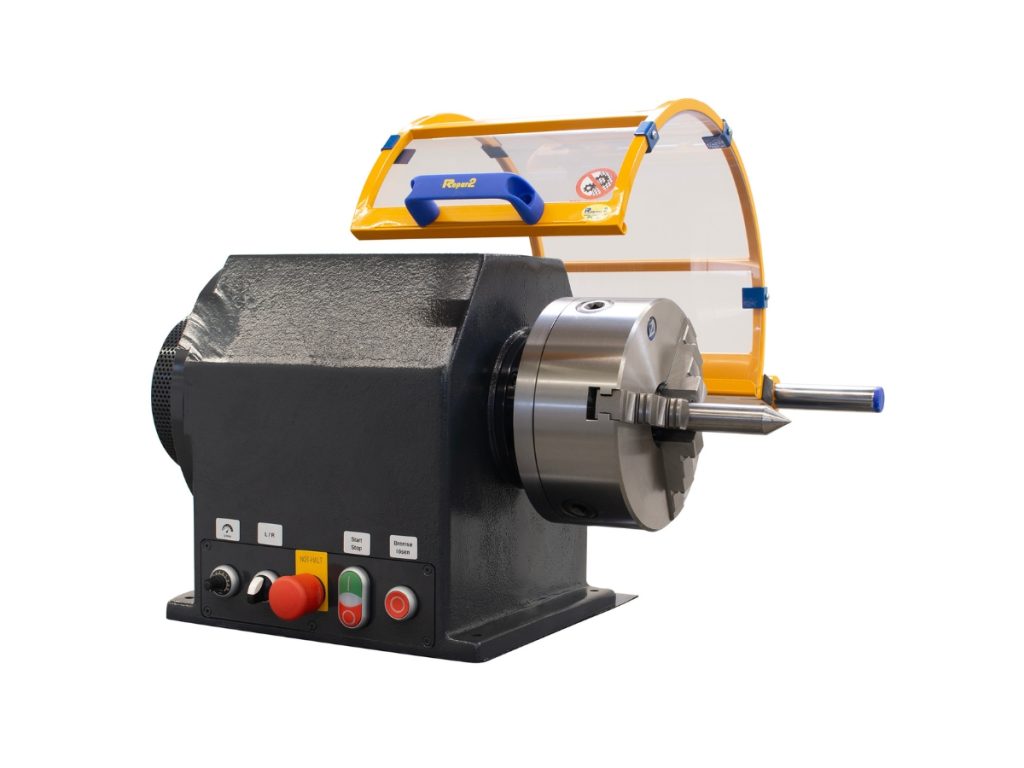
JOKE Polierbock UVM machines incorporate a highly effective electromagnetic brake designed to reduce spindle run-down. Depending on the selected configuration, the system can also incorporate transparent protective hoods, application-specific workholding and an optional safety foot switch with a pressure-point emergency-stop function.
These provisions support a more controlled machine installation, but they do not make it acceptable to hold emery cloth directly against rotating work. The finishing method must still eliminate direct hand exposure and use appropriate workholding, abrasive holding, guarding and operating procedures.
Workshop Assessment Checklist
Before approving a polishing, sizing or deburring process involving a rotating component, establish:
- What finish, edge condition or dimensional result is actually required?
- Can the operation be eliminated or completed during machining?
- Would a dedicated polishing, honing, grinding or linishing machine be more suitable?
- Is the machine manual or CNC?
- Is the operation external or internal?
- How will the component and abrasive or tool be positively supported?
- Can access to every dangerous moving part be prevented?
- Are speed, direction of rotation and contact position appropriate?
- What happens if the abrasive, holder or component moves unexpectedly?
- Are stop controls accessible, and what is the measured run-down behaviour?
- Are guards, interlocks, stop controls and braking systems maintained and tested?
- Does clothing, hair, jewellery or PPE introduce an entanglement risk?
- Have operators and supervisors received task-specific training?
- Is the method documented, supervised and reviewed when anything changes?
The assessment should cover the complete working system, not the machine in isolation. It must also address other relevant hazards such as ejected material, sparks, abrasive dust, noise, heat, component security and safe maintenance.

JOKE Polierbock: A Configurable System for Controlled Finishing
Where the risk assessment establishes that a conventional production lathe is not the most suitable equipment for the finishing process, a purpose-built polishing and precision-lathe system allows the machine to be specified around the component, finishing method and working environment.
JOKE Polierbock UVM systems provide a configurable foundation for polishing, grinding, sanding, filing, scraping, deburring, brushing, chamfering and processing shafts, spindles, axles and tube sections. The appropriate system is selected according to the required speed control, workpiece support, tool positioning, guarding and level of operator control.
Choosing the Polierbock System Architecture
| Polierbock system | Role within the finishing process |
|---|---|
| Junior | Compact base machine with three selectable speed settings for consistent, repeatable processes using defined operating speeds. |
| Regatron | Compact base machine with continuously variable speed control for processes requiring precise adjustment between components, materials, tooling diameters or finishing stages. |
| Praktika | Combines a Junior or Regatron drive system with a baseplate and tailstock for supported processing of shafts, spindles, axles and tube sections. |
| Mechanika | Combines a Junior or Regatron drive system with a baseplate and precision cross-support for controlled positioning of the processing tool. |
| Ergonom | A separate variable-speed system designed around the ergonomic processing and handling of larger or heavier workpieces. |
| Special machine | An individually engineered Polierbock arrangement for applications requiring bespoke workholding, guarding, controls, extraction or workplace integration. |
Engineering the Complete Machine and Process
Polierbock is not limited to the drive unit. Each system can be configured with appropriate workholding, controls and protective equipment to create a complete machine around the intended operation.
Available provisions include:
- Highly effective electromagnetic braking to reduce spindle run-down after the stop function is activated
- Transparent protective hoods matched to the selected chuck size
- Optional safety foot switches incorporating a pressure-point emergency-stop function and manual reset
- Three-speed or continuously variable control according to the selected drive system
- Alternative chucks, collets and clamping arrangements selected around the component
- Tailstock support for shafts, spindles, axles and tube sections
- Precision cross-supports for controlled tool positioning
- Machine bases, extraction and workplace options configured around the installation
These provisions allow the machine architecture, stopping performance, component support and operator controls to be considered together rather than treated as unrelated additions. Moleroda works with JOKE to define the required Polierbock drive system, platform, workholding and protective equipment before providing a configuration-specific quotation.
A Polierbock machine does not make direct hand application acceptable.
Electromagnetic braking, guarding and operator controls support a more controlled installation, but they do not authorise holding emery cloth directly against rotating work or guarantee the safety or PUWER compliance of a process. The complete configuration and method of use must still be assessed.
Every Polierbock is configured and quoted around the application. The complete product guide compares the available systems, speed controls, machine platforms and technical options, and explains the information required for an accurate recommendation.
Frequently Asked Questions (FAQs)
No. HSE guidance states that emery cloth must not be applied directly by hand to work rotating in a manual metalworking lathe. Where a risk assessment concludes that emery cloth remains necessary, it should be held in a suitable tool-post-mounted arrangement.
No. Lower speed does not make direct hand application acceptable. Speed is one part of the wider process assessment, but the abrasive must still be kept out of the operator’s hands and controlled using a suitable method.
Changing to another flexible abrasive does not remove the snagging and entanglement hazard. HSE’s specific guidance concerns emery cloth, but any abrasive cloth or paper used near rotating work must be assessed according to the same machinery-safety principles. It should not be assumed that hand application becomes acceptable because a different abrasive product is used.
No. HSE warns that gloves increase the risk of entanglement near rotating parts of machinery. Clothing, long hair and jewellery must also be controlled so they cannot be drawn into the machine.
Following a suitable and sufficient risk assessment, HSE identifies a looped strip of emery cloth clamped in a suitable tool-post-mounted holding arrangement for external deburring on a manual lathe. The complete setup and operating method must be suitable for the component.
HSE identifies a suitable holding device carried in a boring-bar holder in the tool post, with the emery cloth secured around that device. This keeps the operator’s hands away from the rotating work. The setup must be assessed for access, retention, clearance and contact.
No. An emergency stop supports a rapid response to a dangerous event, but it is not a substitute for guarding or a safe working method. An operator who has already become entangled may be unable to activate it.
An electromagnetic brake reduces spindle run-down after a stop is initiated. It can bring the chuck, workpiece and fitted equipment to rest more quickly, but it cannot prevent the initial snag or make direct hand application of emery cloth acceptable.
No. PUWER compliance depends on the complete work equipment and its use, including suitability, guarding, workholding, controls, installation, maintenance, information, training and the safe system of work. Braking is one supporting protective measure.
Important information:
This article summarises published HSE guidance for general information and is not a substitute for a suitable and sufficient risk assessment, competent machinery-safety advice or the manufacturer’s operating instructions. The employer or other dutyholder remains responsible for the work equipment and process used in their workplace.