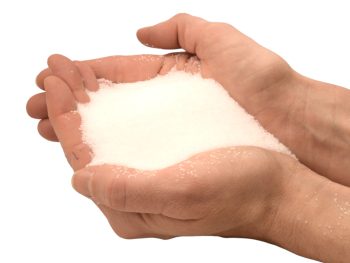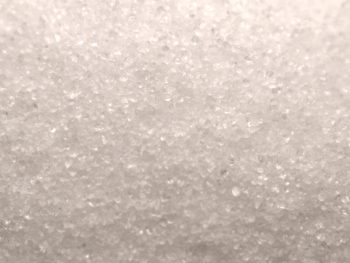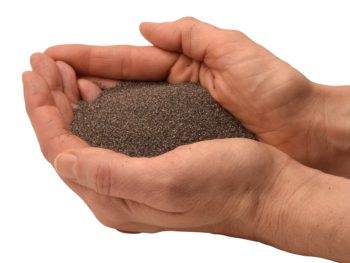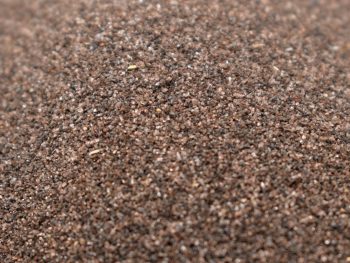


Silica-Free Media for Cleaning & Surface Enhancement
Glass beads clean surfaces through a peening action, gently removing contaminants while maintaining dimensional accuracy and producing smooth or satin finishes.
Suitable for ferrous and non-ferrous materials in wet or dry blasting systems.
Glass beads are selected where surface finish, fatigue resistance, and cleanliness are more important than aggressive cutting.
Key Features
-
Spherical particle shape for non-cutting impact
-
Silica-free – safer alternative to sand
-
Minimal substrate damage
-
Uniform, repeatable surface finish
-
Suitable for ferrous and non-ferrous substrates
-
Compatible with wet and dry blasting systems
Typical Applications
-
Aerospace component peening
-
Stainless steel cleaning and finishing
-
Automotive restoration
-
Tooling and mould surface preparation
-
Removal of light surface contamination
Glass beads improve surface appearance while preserving part geometry.
Why Choose Glass Beads vs Glass grit
Glass beads provide cleaning and peening without profiling, unlike glass grit, which cuts and etches the surface.
They are the preferred choice where surface integrity and finish quality are critical.
Technical Information – Glass Beads
Technical Properties
| Property | Typical Value |
|---|---|
| Chemical composition | Soda-lime glass |
| Particle shape | Spherical/Round |
| Hardness | 6.0 Mohs |
| Specific gravity | ~2.5 g/cm³ |
| Bulk density | ~1.5 – 1.6 g/cm³ |
| Melting Point | ~730°C |
| Contamination risk | None |
| Suitable systems | Wet & dry blast cabinets |
Compatible with pressure, suction, and cabinet blasting systems.
Chemical Properties
| Component | Typical % |
|---|---|
| SiO₂ | 70 – 75% |
| Na₂O | 12 – 15% |
| CaO | 7 – 12% |
| MgO | Max. 5% |
| Al₂O₃ | Max. 2.5% |
| K₂O | Max. 1.5% |
| Fe₂O₃ | Max. 0.5% |
Approvals & Standards
Glass beads are manufactured to meet major aerospace, MoD, and nuclear specifications, including:
- CSS8
- ABP 1-2027/2029
- BAEP 2007
- MIL-G-9954
- MIL-S-13165
- AMS 2431/6 (where applicable)
Certificates of conformity available on request.
Grades & Supply
-
Wide range of bead sizes available
-
Supplied in 25 kg bags
-
UK stock, 3–5 working day delivery
Glass bead size selection influences the degree of cleaning, peening intensity, and final surface appearance.
Larger bead sizes provide increased impact energy for effective cleaning, while smaller bead sizes produce smoother finishes and finer surface textures with minimal dimensional change.
Glass Bead Sizes
| Grade | Avg. Bead Size (µm) |
|---|---|
| Fine | 0 – 44 |
| 0 – 100 | |
| 100 – 150 | |
| 150 – 250 | |
| 150 – 300 | |
| 300 – 400 | |
| 400 – 600 | |
| Coarse | 600 – 800 |
Specialised Glass Peening Beads (AGB6/AMS2431) also available – Contact us
Finer bead sizes are commonly used for cosmetic finishing and fatigue-resistant peening, while coarser beads are selected where increased cleaning action is required.
Final bead size selection should account for substrate sensitivity, finish requirements, and process repeatability.
Unsure which grit size is right for your application? – Contact us
Our technical team can advise on media selection based on substrate, finish, and blasting system.
Safety & Handling
Glass beads are non-toxic and free from crystalline silica.
Spilled material may present slip hazards and should be cleaned promptly. Store in dry conditions, as glass beads readily absorb moisture.