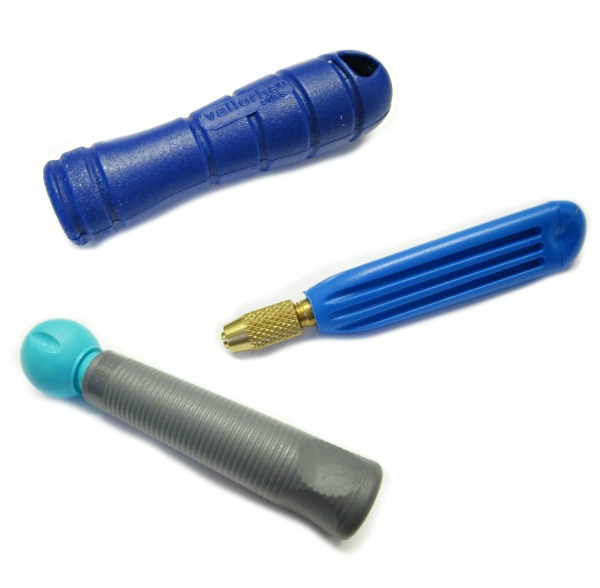

A Reusable Screw-On Handle for Larger Hand Files
The Vallorbe Crocodile VAL410 is a reusable handle for larger 6–8 inch engineering and workshop hand files. Its hardened threaded insert screws directly onto the file tang, providing a secure removable grip without permanently attaching the handle to one file.
The non-slip plastic body offers a larger and more comfortable gripping surface than an exposed file tang, helping the operator guide the file with greater control during manual shaping, fitting, deburring and surface refinement.
The VAL410 is supplied as one file handle only. The file is not included.
Why Use the Vallorbe Crocodile File Handle?
Improved Grip and Control
The shaped, non-slip handle provides a more secure and comfortable gripping surface than holding the file tang directly, helping the operator guide the file using controlled manual strokes.
Secure Threaded Fitting
A hardened threaded insert screws onto the tang of a compatible file, creating a firm connection between the file and handle during use.
Reusable Across Compatible Files
The handle can be unscrewed and transferred between compatible files, making it practical for workshops using several file profiles or cuts.
Which Files Fit the VAL410 Handle?
The VAL410 is designed for larger engineering and workshop hand files in the 6–8 inch size range. It can be used across different file profiles and cuts, provided the file has a conventional tang that can be securely engaged by the handle’s threaded insert.
File length is the main initial selection guide, but tang dimensions can vary between file ranges. Screw the handle onto the tang and confirm that it tightens firmly without movement before use.
The VAL410 is not suitable for needle files, diamond needle files or Quick-Zip carriers.
For precision files with compatible 3–4 mm shanks, choose the FH-40 or VPL-B precision file holders.
Engineering, Trade and Workshop Applications
The VAL410 is intended for routine manual filing with larger hand files, from general workshop deburring and fitting through to fabrication, maintenance and repair work.
Precision Engineering and Manufacturing
- Removing burrs and sharp edges from machined or fabricated components
- Fitting and adjusting mating parts during assembly or repair
- Refining flat faces, radii, holes and profiles with the appropriate file shape
- Cleaning welds, cast edges and local surface irregularities
- Toolroom, maintenance and general engineering work
- Manual stock removal and edge refinement during fitting or repair work
Trade, Restoration and General Workshop Use
- Metal fabrication and mechanical repair
- Tool and equipment restoration
- Automotive and general maintenance work
- Woodworking and shaping with compatible files
- Model engineering and larger detailed components
- Home-workshop and DIY filing applications
Technical Information
| Product type | Reusable screw-on file handle |
|---|---|
| Brand | Vallorbe |
| Range | Crocodile |
| Model | VAL410 |
| Suitable file length | Compatible 6–8 inch files |
| Handle length | Approximately 105 mm |
| Handle material | Non-slip plastic |
| Insert | Hardened threaded insert |
| Fitting method | Screws onto a compatible file tang |
| Operation | Manual hand use |
| Country of manufacture | Switzerland |
| Quantity | Sold individually |
| File included | No |
How to Fit and Use the VAL410 File Handle
- Check that the file is within the recommended 6–8 inch size range and has a clean, undamaged tang.
- Align the file tang with the hardened threaded insert inside the handle.
- Screw the handle onto the tang until the file is held firmly.
- Before use, check that the handle cannot rotate or move unexpectedly on the file.
- Hold the handle securely and use filing strokes appropriate to the file, material and component.
- To change files, unscrew the handle carefully and refit it to another compatible file.
Safety Note:
Do not use a damaged file or handle.
Never use a file with an exposed tang, and ensure the handle is fitted securely before applying pressure.
Wear suitable eye protection when filing.