
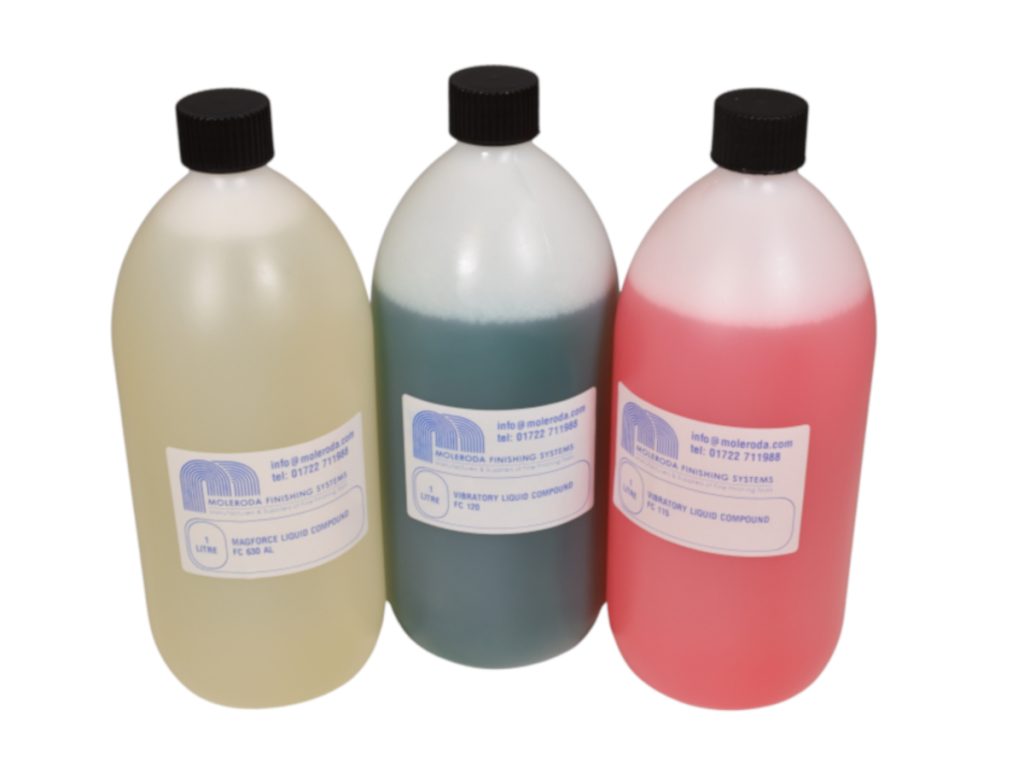
Surface finishing isn’t just about machines and media — the liquid compound you choose plays a critical role in productivity, finish quality, corrosion control, and process repeatability. In modern mass finishing, liquid compounds help lubricate contact points, emulsify oils, suspend debris, and stabilise the process water to ensure consistent, high-quality results.
Moleroda offers three key finishing chemistries built on Rösler mass finishing consumables:
-
FC115 — Heavy-duty corrosion protection
-
FC120 — Universal cleaning & polishing
-
MagForce Magnetic Finishing Compound — Precision magnetic polishing fluid
This guide breaks down when to use each, how they differ, and which process combinations deliver the best results.
Mass finishing is an industrial surface finishing method where many parts are processed together with media and a fluid compound. It automates deburring, polishing, cleaning and surface preparation — far more efficiently than manual finishing.
-
In vibratory finishing, parts and media are vibrated together in a bowl or tub, generating shearing and abrasive motion. Find out more about the process in 🔗The Benefits of Vibratory Finishing
-
In magnetic finishing, small steel pins are propelled by magnetic fields to polish intricate features. Learn more in 🔗What is Magnetic Finishing?
Liquid compounds influence:
-
corrosion resistance (especially for ferrous alloys),
-
surface brightness and cleanliness,
-
foam behaviour,
-
and compatibility with media and machine type.
| Attribute | FC115 | FC120 | MagForce Magnetic Finishing Compound |
|---|---|---|---|
| Best For | Corrosion-prone ferrous metals | Mixed metals & general finishing | Precision magnetic pin polishing |
| Core Function | Corrosion inhibition + debris suspension | Balanced cleaning & brightening | High-speed lubrication & passivation |
| Machine Compatibility | Vibratory & tumbler systems | Vibratory & tumbler systems | Magnetic finishers (MagForce 650) |
| Foam Profile | Low | Moderate/High | Low/Controlled |
| Surface Focus | Prevent rust, support deburring | Clean + polish a broad range | Precision high-gloss on internal features |
| Typical Industries | Fabrication & heavy manufacturing | General machining, jewellery, aerospace | Precision engineering, medical, aerospace |
Best choice when working with steel and other ferrous alloys that are prone to flash rust during wet vibratory finishing.
What it Does
-
Creates a temporary protective film that guards against oxidation during and after finishing cycles.
-
Keeps abrasive fines in suspension so media stays effective longer.
When to Use FC115
-
Processing corrosion-sensitive steels and cast irons
-
Heavy deburring in vibratory bowls or tubs
-
Situations where rust could compromise part quality or post-processing
Explore product details: 🔗FC115 Vibratory Liquid Compound – Heavy-Duty Corrosion Protection
Learn more about the process: 🔗Discover Vibratory Finishing: Efficient, Precise, and Production-Ready
The most versatile finishing compound in the Moleroda range, ideal for shops processing a variety of materials and needing one fluid for multiple finishing stages.
What it Does
-
Balances cleaning, polishing, and mild corrosion control for a wide spectrum of metals and finishes.
-
Works well with plastic, ceramic, or porcelain media.
When to Use FC120
-
Jobs that include cleaning, brightening, and polishing in the same cycle
-
Mixed material batches (steel, aluminium, brass, titanium, precious metals)
-
Situations where machine cleaning/compound changeover is impractical
Explore product details: 🔗FC120 Vibratory Liquid Compound – Universal Cleaning & Polishing
Learn more about the process: 🔗Discover Vibratory Finishing: Efficient, Precise, and Production-Ready
MagForce is a specialist compound based on Rösler FC 630 AL chemistry. Although FC630AL was originally introduced as a vibratory finishing compound, its chemical balance, lubricity, and passivating behaviour make it particularly effective in magnetic finishing systems.
In magnetic finishing, where stainless steel pins are driven at high velocity by a rotating magnetic field, the compound’s role shifts from bulk cleaning to precision lubrication and fine surface conditioning. Moleroda has therefore chosen to supply this chemistry as MagForce Magnetic Finishing Compound, reflecting its validated role in magnetic pin finishing rather than its original classification.
What Makes it Different
-
Provides lubrication and suspension for tiny stainless steel pins so they move freely and reliably.
-
Ideal for parts with intricate internal geometries that larger media can’t access.
When to Use MagForce Compound
-
Magnetic finishing cycles (five-to-30 minutes)
-
Polishing internal bores, blind holes, and fine features
-
Applications where precision surface finish and dimensional control matter most
Explore product details: 🔗MagForce Magnetic Finishing Compound
Learn more about the process: 🔗What is Magnetic Finishing? A Complete Guide…
Compare Processes: 🔗Magnetic Finishing vs Vibratory Finishing
Vibratory vs Magnetic Finishing
-
Vibratory finishing uses media and vibration to abrade and polish entire parts uniformly.
-
Magnetic finishing uses magnetic pins in a high-speed field to reach internal and fine features that vibratory media can’t.
Each process has distinct compound needs — rheology, foaming characteristics, and surface chemistry — which is why a universal vibratory compound can’t fully replace a magnetic-specific fluid.
Deep Dive: 🔗Benefits of Vibratory Finising
Deep Dive: 🔗What is Magnetic Finishing? A Complete Guide…
Compare Processes: 🔗Magnetic Finishing vs Vibratory Finishing
Here’s a quick guide to help you match materials and machines with the right liquid:
If you’re predominantly using vibratory finishing:
-
FC115 for corrosion-sensitive ferrous alloys and heavy cuts
-
FC120 for general industrial finishing and mixed metals
If you’re using magnetic finishing:
- MagForce Compound is built for the physics and lubrication of magnetic pins
Multi-stage finishing workflows:
-
Start with FC115 for initial deburring and rust control, then switch to FC120 for final cleaning and brightening.
-
FC115 = corrosion protection + media cleaning for heavy ferrous work
-
FC120 = universal, balanced cleaning & polishing for mixed materials
-
MagForce Compound = specialist fluid for precision magnetic finishing
Each compound has its role in your production workflow — choosing the right one not only improves surface quality but also enhances media life, process stability, and overall efficiency.
To better understand how these compounds work with your machinery and goals, check out these guides:

Liquid Compounds
FC115 Vibratory Liquid Compound – Heavy-Duty Corrosion Protection for Ferrous Finishing


Liquid Compounds
MagForce Magnetic Finishing Compound – Precision Polishing & Brightening for Magnetic Finishers


Machines, Tools & Equipment
Adjusta-Vibe – Small Vibratory Finishing Bowls & Bench Top Systems