
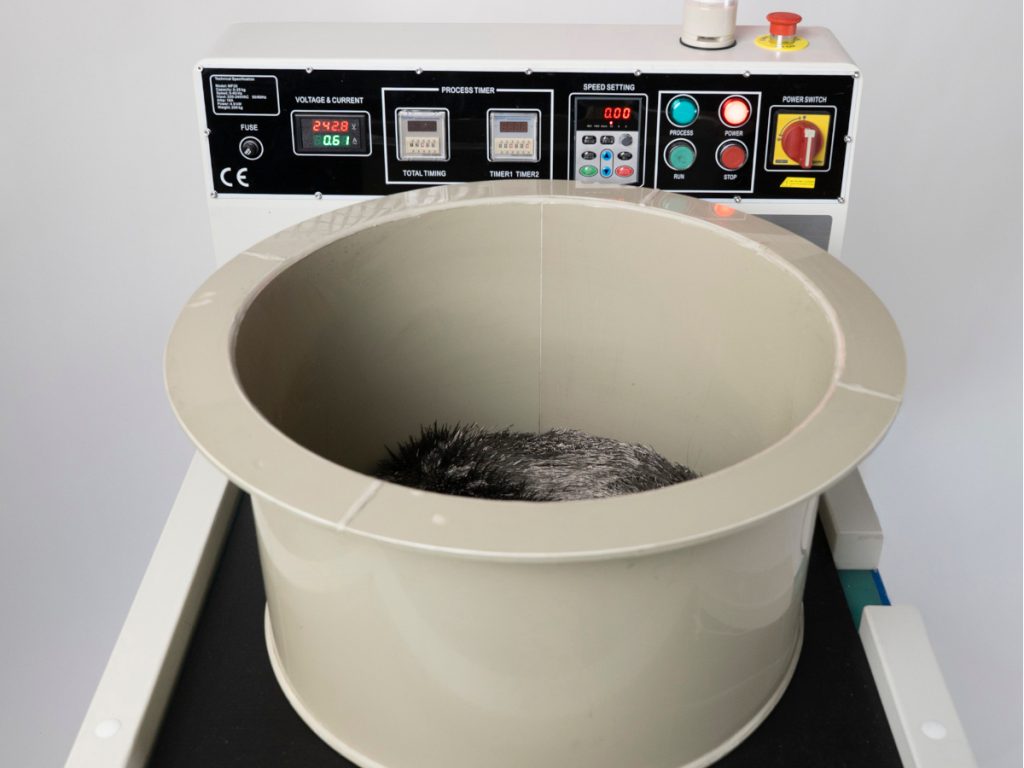
Magnetic finishing is a high-precision industrial surface finishing process used to deburr, polish, and refine small, complex metal components in manufacturing and production environments. Unlike traditional vibratory or barrel finishing, magnetic finishing excels at reaching internal bores, threads, blind holes, and intricate geometries that are otherwise difficult or impossible to finish consistently.
This guide explains how magnetic finishing works, where it is used in UK manufacturing, its advantages and limitations, and when it is the right choice for your production process.
Magnetic finishing (also known as magnetic polishing or magnetic deburring) is a wet finishing process that uses a rotating magnetic field to drive stainless steel polishing pins through a liquid compound.
The magnetic field causes the pins to form a controlled, high-energy polishing action that acts on every exposed surface of the component—externally and internally.
Because the media is magnetically driven rather than mechanically vibrated, the process is highly controlled, gentle, and extremely precise.
🔗 Browse professional magnetic finishing equipment
The process typically involves four core elements:
- Magnetic Finishing Machine (e.g. MagForce 650) – Generates a rotating magnetic field
- Magnetic Polishing Pins (e.g. MagForce Pins) – Stainless steel media that perform the finishing action
- Finishing Compound (e.g. MagForce Liquid Compound) – Liquid chemistry that lubricates, cleans, and stabilises the process
- Process Drum or Bowl – Holds parts, pins, compound, and water
When the machine is activated, the magnetic field forces the pins to rotate at high speed, creating a vortex around and through the components. This motion:
- Removes micro-burrs
- Smooths surface irregularities
- Brightens and refines finishes
- Cleans oxidation and residues
Cycle times are typically 5–15 minutes, making magnetic finishing suitable for both batch production and high-mix manufacturing commonly found in UK subcontract and OEM environments.
Magnetic finishing is especially effective for small to medium-sized components with complex features, including:
- Internal holes and bores
- Threads and cross-holes
- Slots, grooves, and fine details
- Delicate or thin-walled parts
Because the pins are small and individually mobile, they can reach areas that vibratory media cannot.
Magnetic finishing is suitable for a wide range of materials, including:
- Stainless steel
- Carbon steel and iron
- Aluminium
- Copper and brass
- Zinc die-castings
- Precious metals
Material hardness and geometry influence pin size selection, process time, and compound concentration.
Access to Internal Features
Magnetic finishing is one of the most effective methods for polishing and deburring internal geometries without manual intervention.
Fast, Consistent Results
Short cycle times and repeatable process parameters deliver uniform surface finishes across batches.
Reduced Manual Finishing
By automating difficult finishing tasks, magnetic finishing significantly reduces hand polishing, labour costs, and variability.
Gentle Yet Effective
Despite its high energy, the process is controlled and non-aggressive, making it suitable for delicate or precision components.
Clean, Controlled Process
The wet compound flushes away debris, resulting in cleaner parts and a more stable finishing environment.
While highly effective, magnetic finishing is not suitable for every application:
- Less effective on large, flat components
- Not ideal for heavy stock removal
- Part size is limited by machine capacity
- Requires correct pin selection to avoid lodging in holes
Understanding these limitations is key to choosing the right finishing method.
Magnetic finishing is often compared with vibratory finishing, barrel tumbling, and manual polishing.
In general:
- Magnetic finishing excels at precision and internal features
- Vibratory finishing is better suited to larger parts and edge rounding
- Manual polishing is labour-intensive and inconsistent
Magnetic finishing is widely used across UK and European industries that demand high surface quality, traceability, and consistency, including:
- Aerospace and aviation components
- Medical and dental parts
- Electronics and communication hardware
- Precision CNC machined parts
- Springs, clips, and fasteners
- Jewellery and decorative components
Magnetic finishing is ideal if you need to:
- Remove micro-burrs from internal features
- Improve surface finish consistency
- Reduce manual deburring and polishing
- Finish complex, high-precision parts efficiently
For UK manufacturers evaluating magnetic finishing, modern systems integrate machines, media, and compounds into a single, optimised workflow supported by local technical expertise.
If you’re considering magnetic finishing for production use, understanding how a complete magnetic finishing system works is the next step.